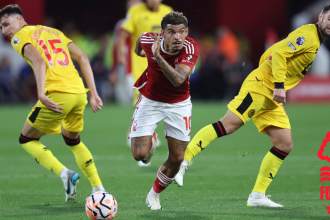
Within today’s penalty-seeking, shirt-grabbing and easy-to-go-to-ground world of modern football, it is becoming increasingly rare to see referees blow up for the once common obstruction rule.
The ‘impending the progress of an opponent’ legislation, as it has documented in FIFA’s Laws of the Game catalogue, states:
‘Impending the progress of an opponent means moving into the path of the opponent to obstruct, block, slow down or force a change of direction by an opponent when the ball is not within playing distance of either player.’
Whilst the rule is still clearly present in the law books, today’s current crop of referees seem completely unwilling to recognise its existence or give it the respective treatment that it is supposed to command. Gone are the days when an indirect free-kick would be given in the box, leaving the opposition players to line-up on the goal-line in a crazed panic and bravely try to keep the ball out of their net at all costs. Although rules such as this one are phased out of the game all the time and represent no real difference as to how teams approach their matches, a certain something certainly feels missing in their absence.
This was also the case for the previously frequent Golden Goal experience, which used to remind us all of the ‘next goal wins’ playground philosophy, as well as the rule stating that keepers may only hold onto the ball for six seconds whilst in play, another rule that is equally ignored despite its presence in FIFA’s official law books.
Such subtle practises mark how the game of football is always changing. To some, referees ignoring the obstruction rule allows for a much better flow in matches, with teams allowed to break away from scrambles in and around the box with much better ease and launch their own counter-attacks. For the most part the lack of hold ups allow for a far greater watching experience.
There is also evidence that the obstruction rule should be brought back into the game, however. Instead of playing on when a player blocks, slows down, or forces a change of direction in their opponent, Premier League referees often blow up for fouls, slowing the game down even more. Fouls often lead to further discussion, and discussion often leads to cards being brandished.
What we have now is a culture of players ‘taking one for the team’ when they cynically block their opponents on the break, and whilst this obviously has no place in the purest form of the game, it means that more and more players are being sent off for fouls that could never be referred to as violent conduct.
The lack of the ‘impending the progress of an opponent’ rule in modern day football also means that more penalties are given when an indirect free-kick would have been the more suitable option. It’s a complete rarity today to watch a match without players from either side looking to go down in the box. Referees often fold to their wishes, but these moments could be equally dealt with if more faith and authority was placed in the obstruction rule. Not every scramble in the area should lead to a penalty after all. It’s not right that the outcome of Premier League matches are increasingly being decided by dubious penalties that should have been given as indirect free-kicks in the box.
Whilst placing so much nostalgia and emphasis on one minor detail of the game may seem trivial in comparison to what we really love about football, the obstruction rule should nevertheless be given more recognition. It is these subtle changes that will build a better game for players, managers and fans alike in future years.
[ad_pod id=’ricco’ align=’center’]